
Keeseville: Then and Now
By Mary Hughes, Photos courtesy of Anderson Falls Heritage Society

In 1926, Keeseville, New York was a lively community situated on the Ausable River which provided the essential power for the development of it as a manufacturing center. Settled in 1808, it was originally known as Anderson Falls. Its name was later changed to Keeseville in honor of local manufacturer and businessman John Keese.
Its growth and success were enhanced by a combination of factors. Natural resources were plentiful: lumber, minerals — including high-grade iron ore mined nearby, stone quarries, conditions and soil suitable for agriculture, the nearby river, and Lake Champlain.
Early settlers laid the foundation for Keeseville to thrive and, in the process, became wealthy from their investments in land and industries. The population grew rapidly as businesses flourished and needed laborers. As transportation improved, visitors arrived via steamboat to enjoy the beauty of the lake, nearby Ausable Chasm and the mountains.

The hamlet, incorporated in 1878, was divided by the river with the Town of Ausable in Clinton County and the Town of Chesterfield in Essex County. It was the crossroad of a north-south international highway from Montreal to points south and the east—west route from Lake Champlain to the Adirondack Mountains. Lodging accommodations, restaurants, and horse and automobile services could be found on Sable Street in the 1920s. The Riverside, the Green Apple Inn, and the Boulé block are still recognizable today.
In the early years of the 20th century Front Street was lined with three-story brick buildings on the side closest to the river. That lesson was learned after previous large fires consumed the street’s wooden structures. The first floors of the buildings were usually a store. The second floors were used for professional offices, and the third floors were living quarters for the owners’ families and other tenants.

Nails were manufactured at the Ausable Horse Nail Company closest to the Arch Bridge and across from the former Keeseville National Bank. The building is now Adirondack Architectural Heritage (AARCH) and ADK Action. The words “HORSE NAILS” are still visible on its front. The next building up the hill was the Nail Company’s shipping office. Today it is the active Ausable Valley Grange No. 973.
In the late 19th and early 20th century dams were constructed to direct the flow of the river to power the many mills and factories on both sides. Still in use today, the 138-year-old suspension “Swinging Bridge,” was a pedestrian walkway. The 149-year-old dual span “Upper Bridge,” was designed for both foot and vehicle traffic. The 181-year-old Arch Bridge provides both foot and two-way vehicle traffic crossing on Main Street. The three bridges all remain prominent features in the village.
On the Chesterfield side, immediately on the left, is Veterans’ Park. In 1926, it was the four-story Hotel Bridgeway, previously known as the Commercial Hotel. Next to the park there was The Photoplay Theatre.
The current site of the Post Office was Gordon’s Restaurant which burned in 1964.
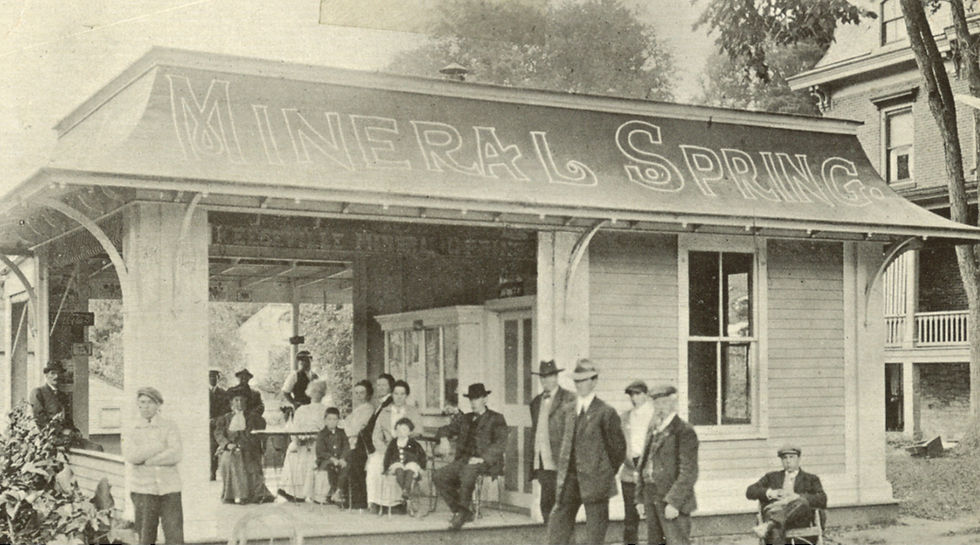
Just past Beach Street is the Mineral Spring which was discovered in 1824. The mineral and chemical composition of the water, which supposedly cured various ailments, attracted people from miles around. Later, the spring’s water was bottled with the name “Dietade.” The bottling company was subsequently acquired by Pepsi-Cola which moved its plant south of town where it is today.
Intersecting Main Street was Front Street, where most of the original businesses were located. On the river side is The Mould Block which encompasses the Village Liquor Shoppe and the Keeseville Free Library. Where the Davidson Real Estate Group, DND Property, D & S Front Street Rentals, and Upstate Records Management are now, was formerly Stone’s Drug Store. When you pass by, look up and you will see the year 1868 written above in the decorative eaves. The Launderette and the Village Roast Coffee Shop currently complete the block.
Across the street, Keeseville Pizza & Deli space was the former Essex County National Bank. Where the Keeseville Pharmacy is today was the impressive Kingsland Opera House. Built 1884, it could seat 400+ people. In the early 1920s, part of the building was converted to accommodate the J.B. Mace store and the Post Office and was renamed The Opera House Block.
The Front Street Fellowship — House of Hope — was originally the Prescott Hardware Store which sold lumber, hardware, and manufactured furniture. Behind Front Street today is Riverside Park.
The Prescott Furniture, Sash, Door and Blind, started in 1864, became a multi-generational family success. As the market for wood products expanded, after the fire of 1876, a five-story factory was constructed. Initially the company made cribs and caskets and employed its own undertaker. With the changing times, their products transitioned and they began to produce household furniture, then wooden radio cabinets, and eventually wooden television cabinets. The Prescott building was not in use when the factory burned in a spectacular fire in 1968.
On the 1719 Block Gallery was Turner’s Drug Store, which had a soda fountain and sold toiletries, smoking supplies, school items, cameras and film, and books.
Also in the downtown area, was Riani’s, famous for its delicious, made in house peanut brittle. The business also sold fruits, vegetables and other groceries. Another Front Street business in the early years was Lavine’s, a women’s clothing store; it is now Cornucopia Gourmet Mushrooms.
In the early days of the 20th century, it was common for people to work in their homes. Dressmakers, milliners, tailors, and seamstresses could be found practicing their craft on Front Street at that time.
The present-day library, previously known as the Lee Memorial Library, which burned in 1926, was rebuilt and, under a new state charter, was renamed The Keeseville Free Library. Then, as now, the end of the Front Street block was anchored by the United Methodist Church.
Travel down Front Street today and you will find St Joseph’s Addiction, Treatment and Recovery Center, formerly Smith’s, a men’s clothing store.
Many of the present-day owners of Front Street buildings have honored their architectural heritage by displaying the original brick walls inside and ornately decorated cornice brackets outside.
Today Keeseville is a tight-knit, welcoming community with well-preserved heritage buildings and historic bridges. The North Star Underground Railroad Museum is nearby as is Ausable Chasm — called the "Grand Canyon of the East." A growing local farm-to-table scene and an increasing number of artisan producers have made Keeseville a must visit place for locals and tourists alike.
Anderson Falls Heritage House Museum
96 Clinton Street
Keeseville, New York 12944
518 834-9219


Comments